
The roughness of a particle can dramatically change its surface area, which is an important determiner for its interactions with light and water in the atmosphere. E.g., for a given type of particle, its ability to nucleate ice crystals tends to scale with surface area. In this project, I am looking at electron micrographs to infer a particles roughness using gaussian differencing and smoothing, a technique used in imaging science for edge detection.
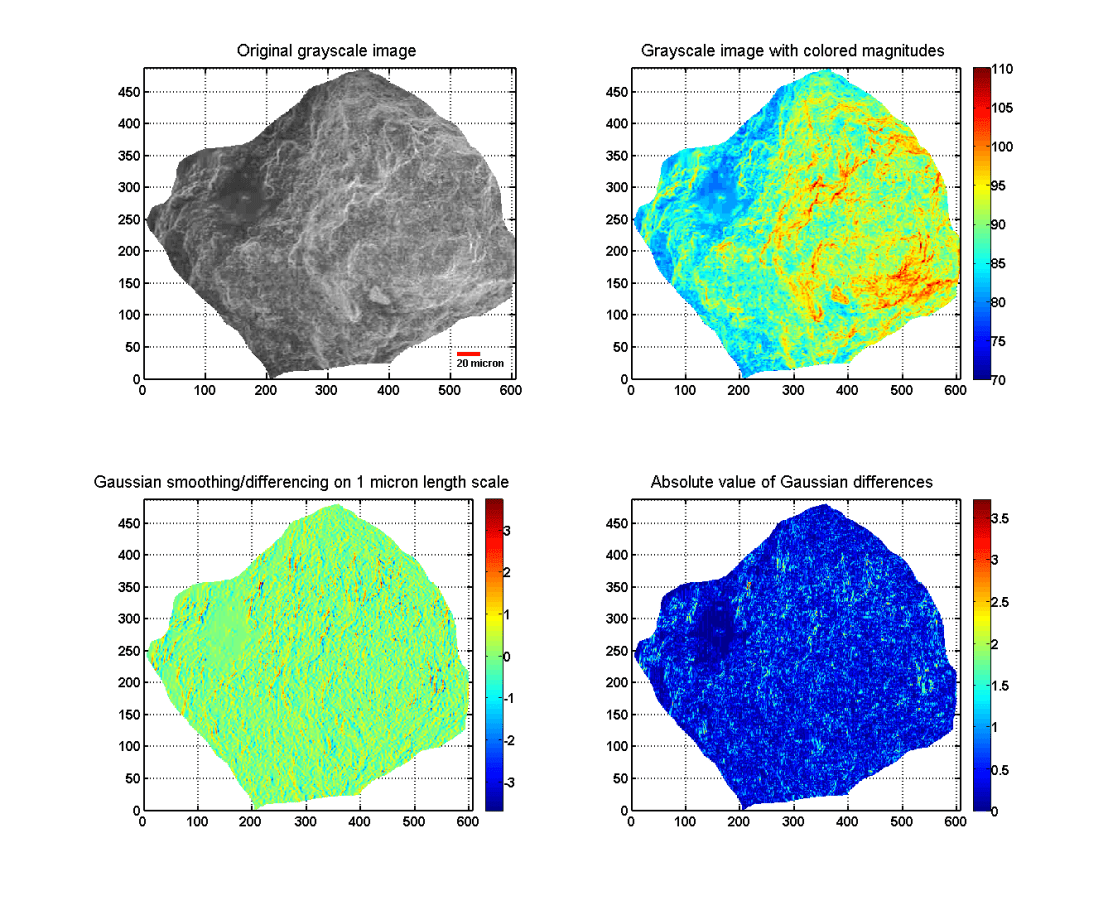
Below is an example where I use this technique on a particular mineral dust particle. The top left panel shows the original electron micrograph of the particle. The top right panel shows the same particle, but now with colors corresponding to the brightness of the image: darker areas are bluer, brighter areas are redder, and areas with sharper transitions from dark to bright (blue to red) are regions with larger roughness.
In the bottom left panel I’ve applied the gaussian smoothing and filtering to the image on a 1 micron length scale, which emphasizes the differences in brightness on this length scale. The bottom right panel shows the absolute value of these differences to highlight areas where they are large.
By taking an average of the bottom right panel, I can come up with a roughness parameter for this particular particle. I can then use this parameter to see how the other properties, such as ice formation potential, scale with particle roughness.
 Sarvesh Garimella